A UGC video ad is a short vertical video that looks like a real customer made it, but that your brand pays for and runs from its own ad account. The ones that work do three things: they open with a hook in the first seconds, they show one product solving one concrete problem, and they get produced in enough variations that you can find the winner on cost per result instead of guessing. We are ByteFusion Labs, an AI video production and growth marketing agency run by brand owners, and this is how we think about UGC-style ads after running our own brands on small budgets.
TL;DR
- A UGC ad is paid, customer-style video run from your ad account. Organic UGC and influencer posts are different things with different controls.
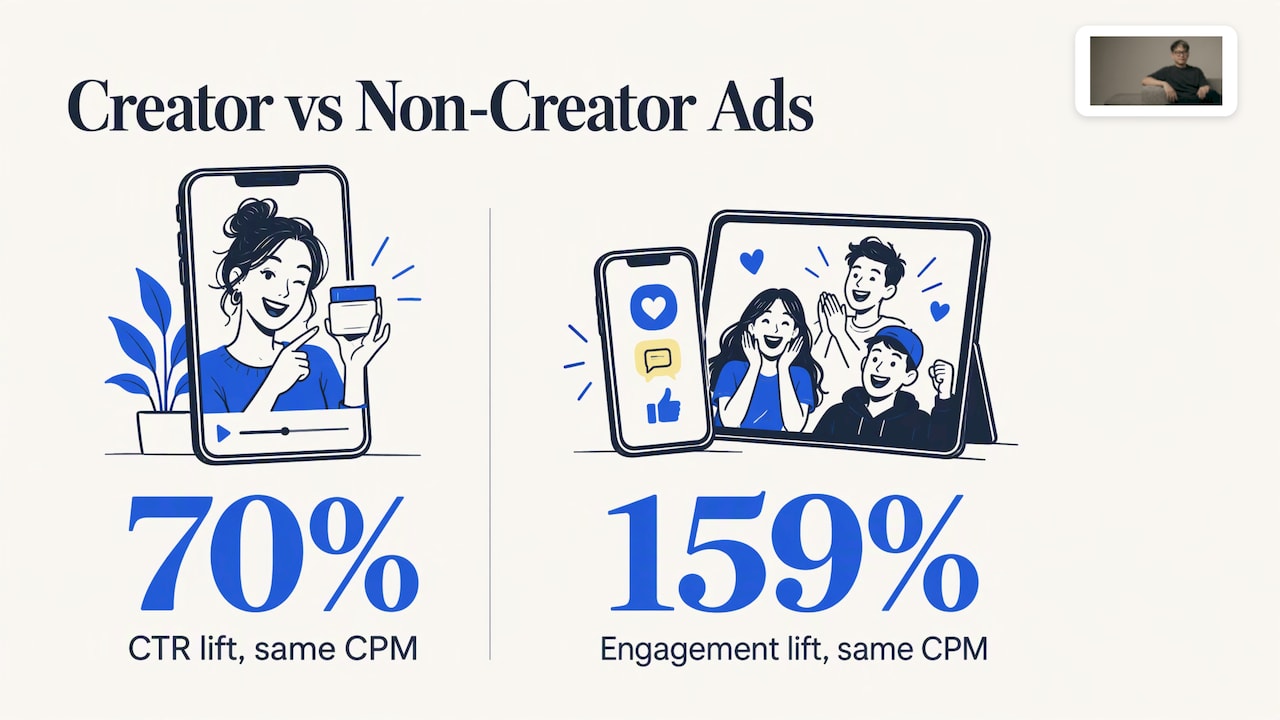
- Creator-led ads can beat standard brand ads: TikTok's own analysis found 70% higher click-through rate and 159% higher engagement at the same cost per thousand impressions.
- Cast for the situation, not the follower count. Write a short brief, then make several hooks per concept.
- UGC-style video can be human-shot or AI-assisted under human review. Either way, check platform AI labels and FTC disclosure rules before you spend.
- Test many variations with a fixed budget per ad, keep the lowest cost per result, and retire the rest.
Table of Contents
- What a UGC video ad actually is
- Why UGC-style ads work
- Human creators, AI-assisted video, or both
- Disclosure and platform rules you need to follow
- Planning a UGC video ad that has a chance
- Testing UGC video ads on Meta and TikTok
- Don't let the landing page undo the ad
- Doing this on a small budget
- How ByteFusion Labs can help
- FAQ
- Sources
What a UGC video ad actually is
User-generated content (UGC) means content made by people who are not your brand's marketing team. The term gets used for three different things, and mixing them up leads to bad briefs and wrong budgets:
- Organic UGC: customers post about you on their own, and you reshare with their permission. It is free, and you cannot order it.
- UGC ads: you pay a creator, or produce the video yourself in a customer style, and run it as an ad from your own account. You control the budget, targeting and the audience.
- Influencer posts: a creator posts to their own followers, so their audience sets the reach. This is a media buy on their channel, not an ad you control.
This three-way split is how Replo's guide to UGC lays it out. The middle one is what this article covers.
On Meta there is a fourth route worth knowing. With partnership ads, an ad can carry a creator's identity in its header while you keep the budget, targeting and optimization in Ads Manager. Meta explains the permission setup for this in its Creator Marketing Hub help page: you request account-level permission from the creator, and once they accept you can run partnership ads without asking for permission post by post. Brands often call this whitelisting. It lets a creator-style video carry a real person's name while you control the spend.
Why UGC-style ads work
The logic is simple. A polished brand ad reads as an interruption. A video that looks like a person talking about a problem they had reads as a recommendation. Backstage's guide to UGC ads, which cites Nielsen research, makes the same case: peer-style content feels like social proof rather than a pitch.
There is platform data too. TikTok's analysis of its own ads, published in its Creator Advantage report, found creator-led ads had a 70% higher click-through rate and a 159% higher engagement rate than non-creator ads at the same cost per thousand impressions. That is TikTok's data on TikTok, so treat it as a reason to test creator-style video on that platform, not a promise for your account.
The second reason matters more to a small brand: UGC-style video is cheap to vary. One concept can become five hooks, three cuts and two calls to action. That is what makes testing possible, and testing is where budgets get saved.
Human creators, AI-assisted video, or both
You have two ways to get the footage, and the right one depends on the product and the claim you are making.
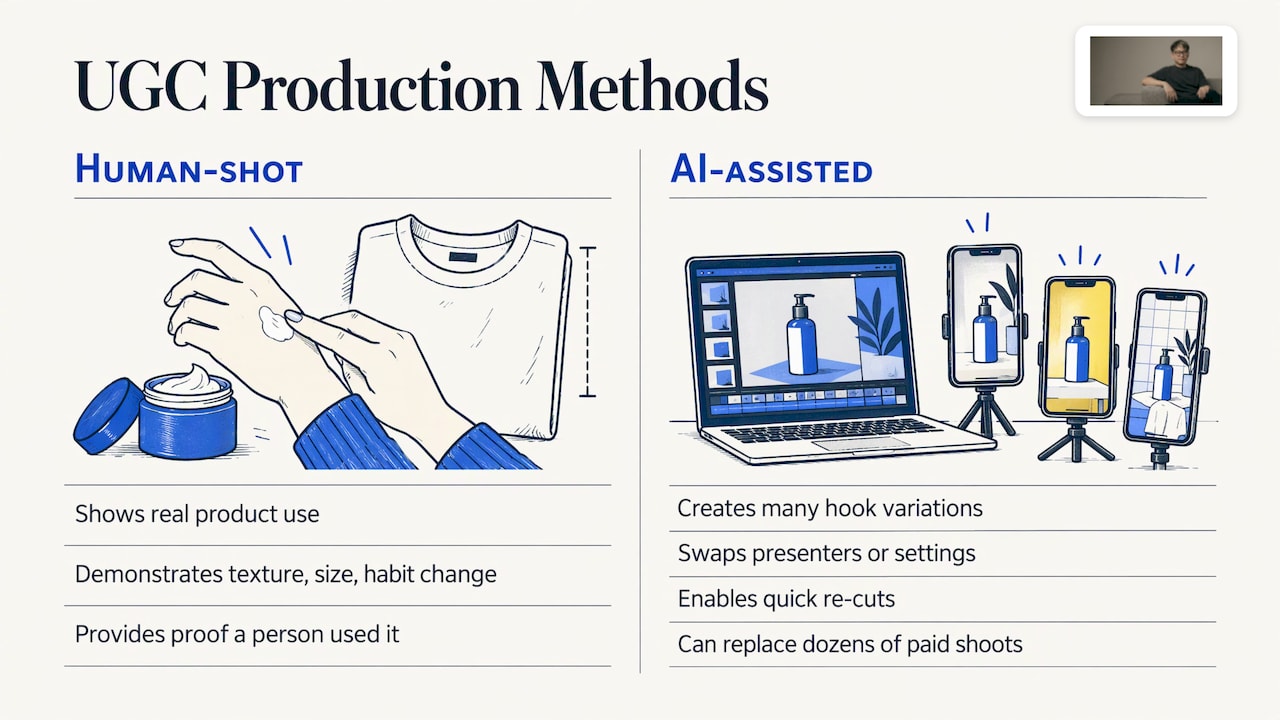
Human-shot UGC is right when the video needs a real person to show something real: a skincare texture on skin, a size on a body, a before-and-after of a habit. The viewer is looking for proof that a person used it.
AI-assisted UGC-style video is right when you need volume and speed: many hook variations of the same idea, different presenters or settings for different audiences, quick re-cuts when a concept starts to tire. It is also the practical answer when your budget does not stretch to dozens of paid creator shoots.
Our own method is the second kind, with a person in the loop. We make short-form videos and video ads in-house with AI tools under human review, then test many variations and keep the ones with the lowest cost per result. Human review is what catches the problems AI video tends to have: odd hands, product details that are wrong, claims that you cannot support, and anything that would read as fake to a viewer. For more on the production side, see our guide to making, testing and scaling AI video ads.
A useful rule: whatever the production method, the product and the claim must be real. A UGC-style ad that shows a result the product does not deliver will cost you refunds, bad comments and possible regulator attention, however well it is made.
Disclosure and platform rules you need to follow
Two sets of rules apply: the law on paid endorsements, and each platform's rules on AI-made content.
Paid endorsements and the FTC
If you are in the U.S. or advertising to U.S. customers, the Federal Trade Commission treats a paid recommendation as an endorsement. The FTC's Endorsement Guides Q&A says a paid review is still an endorsement even if it mentions a negative point, and that the payment should be disclosed. It also says an ongoing relationship with a brand should be disclosed even if the person buys the product with their own money. The guides were revised in 2023.
In practice: if a creator posts for you, or you run their video as a partnership ad, the relationship must be clear on screen. If your ad uses a presenter who is not a real customer, do not write the script as a real customer's story or invent a result. Write what the product does, and show it.
AI labels on TikTok and Meta
TikTok asks advertisers to label ads that contain realistic AI-generated or significantly AI-edited elements. Hootsuite's rundown of TikTok's policy describes an ad disclosure tag, "This ad contains AI-generated content," that you switch on in TikTok Ads Manager. Rules differ by platform and change often, so read the current ad policy in each platform's help center before you launch, and build the label into your launch checklist so no ad goes live without it.
Planning a UGC video ad that has a chance
Most weak UGC ads fail before anyone presses record. They have no clear person, no clear problem and no clear action. Here is the routine we use.
1. Pick one problem and one viewer
Write a sentence: "[Type of person] has [specific problem], and our product fixes it by [specific way]." If you cannot write that sentence in plain words, the ad will ramble. Pull the problem from your reviews, your support inbox and your own use of the product, not from the marketing deck.
2. Cast for the situation
Backstage's guide argues that the best casting choice is not the person with the biggest audience but the one who makes the target customer think "that is exactly my situation." A busy parent, a regular runner or a small-business owner makes the benefit clear at once because they live the use case. Cast, or style your AI presenter, for that. A presenter with a huge follower count who does not fit the use case is wasted spend in an ad, because in an ad the audience comes from your targeting, not their following.
3. Write a short brief, not a script
A brief should cover the problem, the product's role, two or three claims you can back up, what to show on camera, any words to avoid, and the call to action. Leave the exact phrasing loose. A creator reading your script word for word sounds like an ad; a creator who knows the points and says them naturally sounds like a customer. When you produce the video yourself with AI, still write the spoken lines the way a person talks: short sentences, contractions, no brand slogans.
4. Build the hook first
The first seconds decide whether anyone sees the rest. Write five to ten hooks for each concept before you film or generate anything. Common types that you can adapt:
- The problem: show the annoying moment right away.
- The result: open on the outcome, then explain how.
- The mistake: "Stop doing X if you want Y."
- The unboxing or first look: works when the product itself is the draw.
- The comparison: your product beside the usual way of doing it.
The hook is the cheapest thing to change and often the biggest lever, so it is the first thing to vary in a test.
5. Use a simple story arc
For a 15 to 30 second ad, a compact problem-solution arc is enough: the problem, the product in use, one specific proof point, and the call to action. Specific claims beat vague praise. "My kitchen scale stays accurate to the gram" says more than "it's the best scale ever." Only use specifics that you can document.
6. Edit for the feed
Shoot or generate in vertical 9:16. Add captions, because many people watch without sound. Keep cuts quick, and keep the product on screen when it is being talked about. Put key text away from the edges where platform buttons and captions cover it. Check every cut on a phone before it goes live.
7. End with one direct call to action
Tell the viewer exactly what to do next: shop now, get the offer, see how it works. Match the call to action to the landing page they will see. If the ad promises a specific product in a specific colour and the page opens on a general homepage, the click is wasted.
Testing UGC video ads on Meta and TikTok
One ad is a guess. A set of ads is a test. A simple setup:
- Choose two or three concepts. A concept is a core idea: for example, "the morning routine problem" or "the gift angle."
- Make three to five hooks per concept. Keep the rest of the video the same so you can see what the hook changed.
- Give each ad an equal, modest budget and the same audience, so one ad does not win just because it got more spend.
- Decide your metric first. For a store, that is usually cost per purchase. Click-through rate and view-through rate show where the ad loses people, but cost per result is the number that pays the bills.
- Let each ad gather enough data before you judge it. Killing ads after a few hours rewards luck. Use the platform's learning period guidance in its help center.
- Keep the winners, retire the losers, and brief the next round. Take what the winners share (the hook type, the presenter, the proof point) and make more like them.
On Meta, remember that partnership ads let you run a creator's identity while you keep the controls, which makes it easy to test the same video with and without the creator's handle. On TikTok, test native-feeling creator-style ads against your more polished ones, since TikTok's data suggests the creator style can pull ahead on click-through and engagement.
Testing needs a supply of fresh creative. This is the main reason we make video in-house: when a winner starts to tire, we already have the next cuts coming. Creative fatigue is the quiet killer of ad accounts, and a brand that makes one video a month runs out of road quickly.
Don't let the landing page undo the ad
A good UGC ad can still lose money on a bad page. Keep these in line:
- Message match. The page should open on the same product, promise and tone as the ad.
- Speed. Most UGC clicks come from mobile. A page that loads slowly loses people before they see anything.
- Proof near the top. Reviews, the same presenter or customer-style video, and a clear price.
- One main action. A single button to buy, not a menu of choices.
If conversion is low but click-through is high, look at the page before blaming the video.
Doing this on a small budget
You do not need a big production budget to start. You need a clear problem, a few variations and the discipline to read the results.
- Start with one product and one problem. Do not try to sell your whole catalog in one ad.
- Spend your effort on the hook, because it is cheap to vary.
- Reuse what you have. Real customer reviews, photos and your own product footage can be turned into UGC-style video.
- Post winning concepts as organic short-form video on TikTok, Instagram Reels and YouTube Shorts too. A video that holds attention in paid is worth testing organically, and the reverse also works.
- Set a ceiling per test and stick to it, so a failed concept costs a small amount, not a month's budget.
This is how we grew our own brands, Natridy, AuraPura and MageGee, on small budgets, and it is the same playbook we use for partner brands. You can see the brands on our Brands We Built and Run page.
How ByteFusion Labs can help
If you would rather have a team make and test this for you, that is what we do. We are an AI video production and growth marketing agency run by brand owners. We make short-form video and video ads in-house with AI under human review, test many variations on Meta, TikTok and Instagram, and scale the winners on cost per result. Founder Shaolong Lin leads every project personally, and our work covers organic AI content and video, brand building and storefronts, and retail placement. See the services page for what each includes.

We work with consumer and DTC brands on partnerships where we share the outcome. If you want to know how that kind of arrangement works, our guide to revenue share marketing covers what to put in writing. To talk about your brand, start from the ByteFusion Labs homepage.
FAQ
What is a UGC video ad?
It is a paid short video, made to look like a real customer or creator talking about your product, that you run as an ad from your own account. You control the budget, audience and creative testing. That separates it from organic UGC, which customers post themselves, and from an influencer post, which goes to the creator's own followers.
Can I use UGC for ads?
Yes, but get permission first. If a customer posted it, ask for written permission to use it as an ad. If a creator made it for you, agree usage rights in writing. On Meta, partnership ads let you run a creator's post with their identity once they give permission in the platform. If the person was paid or got free product, the FTC says the relationship should be disclosed.
Can AI-made videos be used as UGC-style ads?
Yes, as long as the product and claims are real and you follow the platform's AI labeling rules. TikTok, for example, has an ad-level AI disclosure setting in Ads Manager for ads with realistic AI-generated or heavily AI-edited content. Human review before launch catches errors that would hurt trust.
How many UGC ad variations should I test?
Start with two or three concepts and three to five hooks each. That gives you enough variety to find a pattern without spreading a small budget too thin. Judge them on cost per result once each has had enough spend to be meaningful, then make the next round from the winners.
Do UGC ads work on both TikTok and Instagram?
The format suits both, since both are vertical, sound-on and feed-native. TikTok's own analysis found creator-led ads beat non-creator ads on click-through and engagement at the same cost per thousand impressions. Test the same concept on each platform, because audiences and costs differ.
Sources
- Replo: UGC meaning, with real UGC ad examples
- Meta: Manage account-level permissions for partnership ads in Creator Marketing Hub
- TikTok for Business: The Creator Advantage
- Backstage: How to Make Effective UGC Ads
- FTC: Endorsement Guides, What People Are Asking
- Hootsuite: TikTok AI disclosure policy