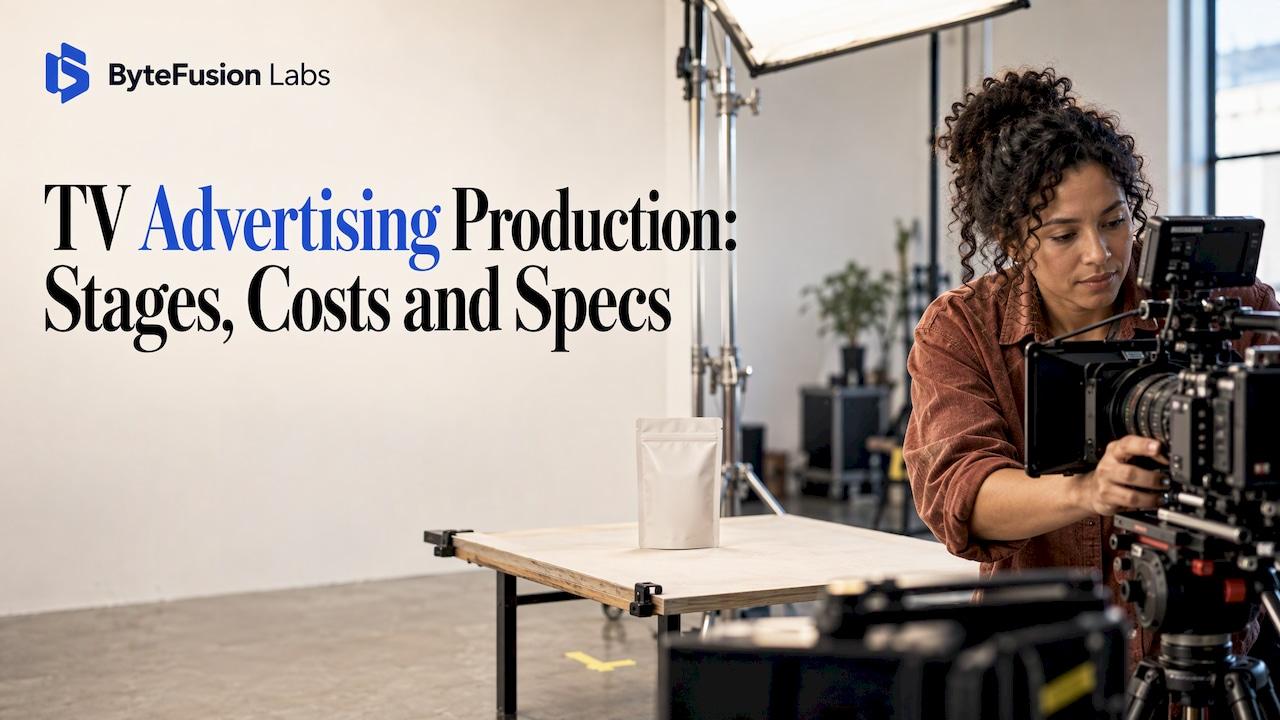
TV advertising production is everything it takes to turn a brief into a finished commercial that a broadcaster or streaming platform will accept: concept, script, shoot, edit, sound and delivery. It is a separate budget from the airtime that puts the spot on screen, and for a brand entering the U.S. market the best result comes when the commercial is built together with the storefronts, short-form video and retail placement it has to support. That is how we work at ByteFusion Labs: our services cover organic short-form video and TV commercials alongside brand building, storefronts and retail outreach, so the spot is made for a sales plan and not for a showreel.
This guide walks through what a TV commercial production involves, what drives the cost, which technical rules apply before delivery, and how to approach it when your budget is limited.
TL;DR
- A TV commercial has two separate budgets: production (paid once, mostly) and media (paid every time it airs). Plan both before you hire anyone.
- Production runs through five stages: brief, creative, pre-production, shoot, post and delivery. Most overruns come from a vague brief and too many approvers.
- Costs run from a few thousand dollars for a simple local spot to well over $1 million for a premium national one. Crew days, locations, talent, effects and music are the main drivers.
- U.S. stations must meet ATSC A/85 loudness rules for commercials, so audio mastering is part of delivery, not an afterthought.
- On a limited budget, make one strong commercial plus a library of organic short-form cuts, and tie the whole thing to where the product is actually sold.
Table of Contents
- Production and airtime are two different bills
- What happens in each stage of a TV commercial
- What a 30-second TV commercial costs to produce
- Technical requirements before a spot goes to air
- Making a TV commercial on a limited budget
- Why the commercial should be built with the sales plan
- How ByteFusion Labs can help
- A planning checklist before you brief anyone
- FAQ
- Sources
Production and airtime are two different bills
First-time advertisers often ask what a TV ad costs and get two answers that seem to contradict each other. The reason is simple. Production is the cost of making the film: concept, crew, talent, editing and delivery. Airtime, also called media, is the cost of showing it: the 30-second slot on a station, or the cost per thousand views on a streaming service.
Production is paid once, although usage rights for talent and music may need renewing. Media is paid every time the campaign runs. A brand that spends its whole budget on a beautiful film has nothing left to air it, and a brand that buys heavy airtime for a weak film pays to broadcast something people ignore.
A media buyer plans and purchases the advertising space; a production team makes the asset. This article is about the second job. If you are a small brand, the practical lesson is to decide your media budget first, then size the production to leave that budget intact.
What happens in each stage of a TV commercial
The stages are consistent whether the spot is shot on a studio set or a phone. Two industry guidelines, one from the UK advertisers' association ISBA and one a European production guideline for advertising commercials, describe the same sequence from client brief to transmission. Here is how it plays out in practice.
1. The brief
The brief states what the commercial must achieve. The European guideline says it should be specific about its purpose and confirmed in writing. "Raise awareness" is not a brief. "Get shoppers in a big-box pet aisle to recognize our package and choose it over the incumbent" is.
The same guideline recommends naming one person in the client organization who carries responsibility for all briefing and approvals, because layered approval stages add cost. For a small team this is easy to follow: one owner decides, and everyone else gives input before the shoot, not after.
2. Budget and timetable
The guideline treats setting the budget as the first planning step, keeping the total in mind as resources are allocated, and agreeing a realistic timetable early. Compressed schedules, it says, only increase cost and risk. Rush jobs are expensive because crew, locations and editors all have to be booked at short notice.
3. Creative and script
This is the stage where the idea becomes a script and storyboard. A 30-second spot has room for roughly one idea, one product promise and one call to action. The most common failure is trying to say three things.
A few choices consistently help a commercial communicate:
- Show the product early and in use. Viewers should know what is being sold within the first few seconds, especially on connected TV where they can skip or look away.
- One promise, said visually. If the benefit can be demonstrated, demonstrate it rather than narrate it.
- Design for sound-off and sound-on. Captions and clear on-screen product shots protect the message in either case.
- End on the place to buy. For a consumer brand this means the retailer, the storefront or the search term, not just a logo.
Wieden+Kennedy senior producer Jennie Lindstrom, speaking in Ad Age's New School Video report, argues that production should be involved early in planning, because producers can offer creative suggestions, realistic timelines and sensible budgets. Bringing the production team in at the script stage, not after the script is locked, is cheaper than fixing it later.
4. Pre-production and the shoot
Pre-production covers casting, locations, props, schedules and permits. The shoot itself is where the day rate clock runs: crew and equipment are billed by the day, so every extra location or company move costs money. A studio is cheaper to control than an on-location shoot. For a product-led spot, a tight set with a few well-lit setups often beats an ambitious multi-location script.
5. Post-production and delivery
Post-production includes the edit, color, graphics, sound mix and music. Heavy visual effects can cost as much as the shoot. The final step is delivery: producing the master files in the formats each broadcaster or platform requires, including different lengths (15, 30 and sometimes 60 seconds) and the versions needed for web, social and mobile. The Ad Age report notes that modern budgets must now account for these digital extras and the post work needed to fit each platform.
What a 30-second TV commercial costs to produce
There is no single price, and any source that gives one is describing a particular tier. The most useful anchor is the range: Ad Age's report notes that 30-second commercials averaged around $350,000 in production costs for most of the decade before its 2012 data, ranging from about $10,000 for small-crew cable spots to Super Bowl productions topping $1 million. Those figures are more than a decade old and national-scale, so treat them as the shape of the market, not a quote. Local and regional spots made with small crews sit far below the national average.
What moves a budget up or down is predictable:
| Cost driver | Keeps it lower | Pushes it higher |
|---|---|---|
| Concept and script | One clear idea, written before booking crew | Multiple rounds of rewrites and approvers |
| Crew and equipment | Small crew, few shoot days | Large crew, specialty gear, overtime |
| Locations | One studio or controlled set | Several on-location setups, permits |
| Talent | Non-union or real customers, limited usage term | Union talent, broad usage and long terms |
| Post-production | Clean edit, simple graphics | Heavy VFX and animation |
| Music | Stock or library tracks | Licensed hits or original scores |
Two cost lines surprise newcomers. The first is talent usage: actors are typically paid for how long and where the spot runs, so a longer term costs more. The second is versioning, since every extra cut and format takes editor time.
The factor you control most is the brief. The European guideline's advice on a written brief and a single approver is not bureaucracy; it is the cheapest way to avoid reshoots.

Technical requirements before a spot goes to air
A commercial can be creatively perfect and still be rejected at the station. Audio loudness is the usual culprit.
In the United States, the FCC's rules require that television stations comply with the ATSC A/85 recommended practice, as it concerns transmission of commercials, effective December 13, 2012. The rule is in 47 CFR 73.682, and it covers measuring loudness and making sure the dialnorm metadata matches the actual content loudness when audio is encoded.
The practical meaning for you: your spot's sound mix needs to hit a target loudness so the commercial is not noticeably louder than the program around it. The Audio Engineering Society's loudness management chapter recommends delivery specs reference ATSC A/85 and use the ITU-R BS.1770 measurement method, with short-form content set to an average program loudness such as -24 LKFS with a stated tolerance (its example is plus or minus 2 dB).
A working checklist for delivery:
- Ask the destination (station, network or streaming platform) for its written delivery spec before the mix.
- Have the mixer measure integrated loudness, true peak and channel order against that spec.
- Keep the loudness report with the delivery files.
- Prepare each length and aspect ratio as its own master.
Specs differ by destination, so always work from the one you are given and not from a generic number.
Making a TV commercial on a limited budget
A smaller budget does not mean a bad commercial. It means choosing where to spend. GE global creative director Andy Goldberg, quoted in the same Ad Age report, describes fixed budgets as forcing marketers to ask how much value each piece will deliver and where to invest a lot and where to invest a little.
Three approaches work for brands with limited money:
Shoot lean, on purpose. The Ad Age report quotes KFC's chief marketing officer Kevin Hochman on using lower-cost methods such as phone video for one campaign, noting that the less polished, real-time style let KFC make much more content at a far lower rate, because audiences are used to that look in those channels. The principle holds for a young brand: a simple, honest demonstration of the product is often better than a staged production you cannot afford to do well.
Make one spot, cut many assets. Shoot once with the full set of formats in mind. A single shoot day can yield a 30-second TV cut, 15-second cutdowns and vertical short-form clips for social platforms. Most of the cost is in the crew day, so the extra cuts are comparatively cheap.
Do not make a spot you cannot support. BBDO's Rolfe, also quoted in the report, advises against making a spot if the client cannot spend enough or the team is not fully behind the idea. Translated for a small brand: if the media budget cannot give the spot meaningful repetition, put the money into organic video and retail execution first and add television when the sales base supports it.

Why the commercial should be built with the sales plan
Most production companies end their work when the files are delivered. A consumer brand, though, does not win on a film. It wins when a shopper finds the product, trusts the listing and buys it, online or on a shelf. That is why we treat the commercial as one asset in a larger system.
When the film, the organic short-form video, the localized storefront and listings, and the retail outreach are planned together, the same footage works at several points: it plays on screen, it sits on the product page, and it supports the conversation with a retail buyer. Our work for brands such as MageGee, Natridy and AuraPura follows this approach, and you can see the brands we built and run on our work page.
There is also a cost logic. Our partnership model ties our compensation to results through a share of GMV (gross merchandise value, meaning total sales) rather than a pure fee for hours, so the production is planned around sales outcomes. We apply the playbook we built launching our own brands on limited budgets, and the founder leads projects personally.
How ByteFusion Labs can help
If you are a brand entering the U.S., or a brand that needs organic growth and retail shelf presence on a tight budget, we can produce your organic AI-assisted content, short-form video and TV commercials, build your storefronts and listings, run marketplace operations and handle online and offline retail outreach, from major chains such as Target to independent stores. See the full list on our services page.

If you would rather talk through your product and your market first, start from the ByteFusion Labs home page.
A planning checklist before you brief anyone
Use this before the first call with any production team:
- Write a one-sentence objective and the single action you want from viewers.
- Set the media budget first; size production to what remains.
- Name one approver on your side.
- List every format you need: TV lengths, connected TV, web, social, retail screens.
- Decide the usage term for talent and music, and where the spot will run.
- Ask for the destination's delivery spec in writing.
- Plan the shoot so the product is the hero and the locations are few.
- Decide where the viewer goes next: retailer, storefront or search term.
FAQ
What is the difference between TV advertising production and TV advertising?
Production is making the commercial: concept, shoot, edit and delivery. Advertising, in the media sense, also includes buying the airtime that runs it. They are budgeted separately, and production is mostly a one-time cost while airtime is paid each time the campaign runs.
How much does a 30-second television ad cost to produce?
It depends on the tier. Ad Age's report puts the long-run national average near $350,000, with small-crew cable spots around $10,000 and the biggest productions above $1 million. Local spots with small crews cost far less. Crew days, locations, talent usage, effects and music drive the difference.
How long does it take to produce a TV commercial?
The time varies with the scope, but the European production guideline stresses agreeing a realistic timetable early, because compressed schedules add cost and risk. A clear written brief and a single approver are the best ways to keep the schedule short.
Do TV commercials have technical delivery requirements?
Yes. In the U.S., stations must follow the ATSC A/85 loudness practice for commercials under FCC rules, so your sound mix should be measured against the destination's spec before delivery. Keep the loudness report with your files.
Can a small brand afford a TV commercial?
Yes, if the spot is simple and the production is planned to produce many assets from one shoot. Lean shooting methods, a single clear idea and a protected media budget make television realistic for a young brand.