Instagram Reels marketing works when you treat every Reel as a test: one clear hook, one message, one measured result, then more of whatever wins. Reels can reach people who don't follow you, so a small brand can get discovered without a big following. They also run as paid ads, so the same video can be tested for cost per result before you scale it. We are ByteFusion Labs, an AI video production and growth marketing agency run by brand owners. We make short-form videos in-house with AI tools under human review, and the playbook below is the one we use on our own brands and for partner brands.
TL;DR
- Reels are shown in the Reels feed and Explore, so they can reach non-followers. Sends (shares to friends) are among the strongest signals, according to Instagram's head.
- Show the brand and the main message in the first 5 seconds, show the product more than once and use a clear call to action. Meta's research links each of these to stronger purchase intent.
- Build for 9:16 with sound, and keep the bottom 35% of the frame clear of text and logos.
- Test one change at a time, for about two weeks, and judge it on hook rate, hold rate and cost per result.
- Post what works organically, then put budget behind the winners as Reels ads.
Table of Contents
- What Reels marketing is and why brands use it
- Pick one goal per Reel
- Build the Reel: hook, message, proof, call to action
- Organic Reels: cadence, trends and repurposing
- From organic to paid: turn winners into Reels ads
- A two-week Reels creative test you can run on a small budget
- Mistakes that waste Reels budget
- How we run Reels for brands
- FAQ
- Sources
What Reels marketing is and why brands use it
Reels are short vertical videos. Unlike a feed photo that mostly reaches your followers, a Reel can appear in the Reels feed and in Explore, so one video can reach people who have never heard of you. Reels can also be found through search and audio, and product tags let a viewer tap from the video straight to a product page. That shortens the path from "I saw this" to "I bought this."
The attention is there. Meta reports that video makes up more than 60% of time on Facebook and Instagram, and about 50% of Instagram time is spent on Reels. In a Meta-commissioned 2023 survey of 6,758 heavy short-form video viewers in seven countries including the US, 79% said they had purchased after watching Reels. That is a company-run survey of a specific group, so read it as a sign of intent, not a promise about your results.
Independent data points the same way on reach. Buffer's analysis of more than 4 million posts found that Reels got 36% more reach than carousels and 125% more than single-image posts, while carousels earned 12% more engagement than Reels. Reels are the reach format. Treat them that way.
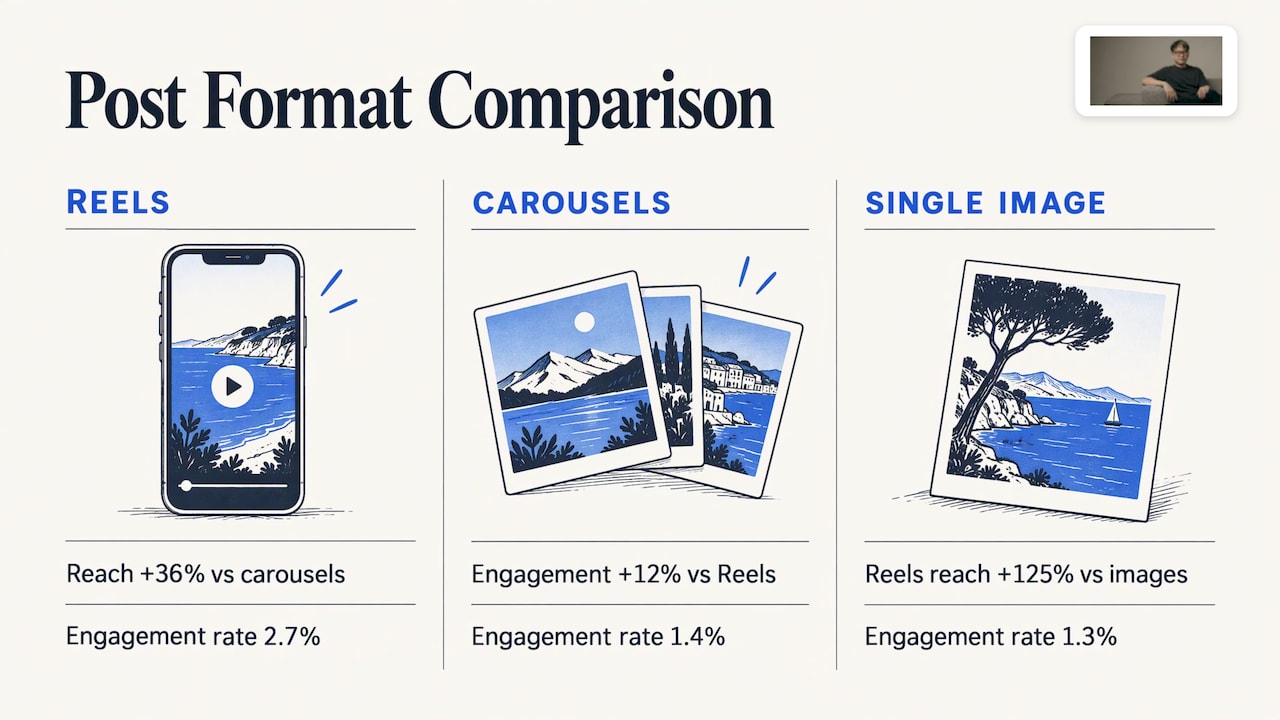
Dash Social's benchmark of 3,363 Instagram company accounts, covering July to December 2025, found Reels averaged a 2.7% engagement rate against 1.4% for carousels and 1.3% for static images. The same report says viewers watch a Reel for about four seconds on average before moving on. That number should shape everything about how you open a video.
Pick one goal per Reel
Most weak Reels try to do four jobs. Pick one. Hootsuite's grouping is a useful way to choose, because each goal has a Reel type that fits it:
| Goal | Reel type | What it earns |
|---|---|---|
| Authority | Tutorials, how-tos, myth-busting | Saves |
| Reach | Trend-led, entertaining, shareable | Sends and new viewers |
| Community | Behind the scenes, day in the life, customer clips | Followers who turn into fans |
| Sales | Product demos, launches, tagged products | Clicks and purchases |
For a DTC brand with a small budget, a workable mix is mostly reach and proof Reels with a smaller share of direct sales Reels. The reach Reels fill the top of the funnel. The proof Reels (customer-style clips, demos, before and after) give people a reason to trust you. The sales Reels then have warm viewers to work on.
One signal deserves special attention. Instagram head Adam Mosseri has said that sends per reach, meaning how many viewers sent the video to a friend, is one of the best performance signals. So ask a plain question before posting: would someone send this to a friend? A useful tip, a funny recognizable situation or a surprising result all pass. A generic brand announcement usually doesn't.
Build the Reel: hook, message, proof, call to action
The first seconds decide the rest
Hootsuite recommends hooking viewers in the first one to two seconds. With an average watch of four seconds, that is realistic advice. Start on the result, the problem or the product in use. Skip logos, intros and "hey guys."
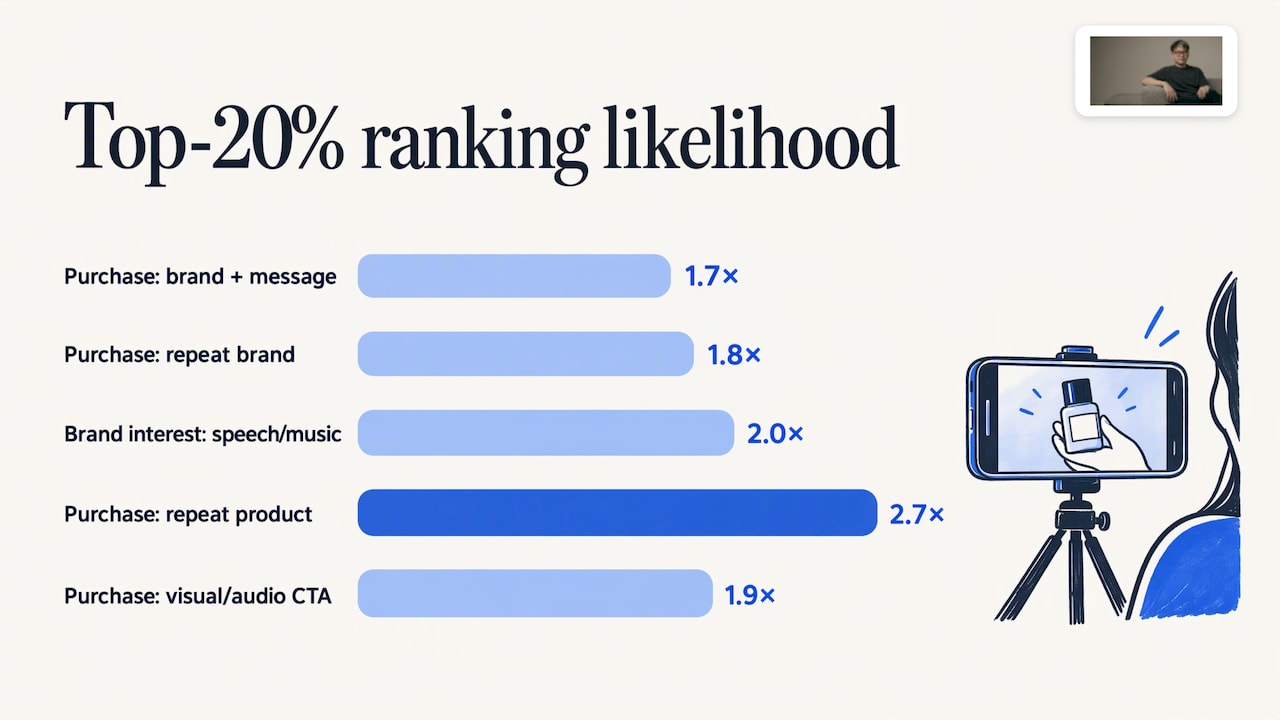
Meta's December 2025 creative research gives numbers to work with. Among Reels creatives, showing the brand and main message within the first 5 seconds made a video 1.7x more likely to rank in the top 20% for purchase intent. Showing the brand more than once made it 1.8x more likely, and using both speech and music made it 2.0x more likely to rank high for brand interest. For direct-response goals, showing the product more than once made a video 2.7x more likely to rank in the top 20% for purchase intent, and a visual or audio call to action made it 1.9x more likely.
In practice, that gives you a simple structure for a 15 to 30 second product Reel:
- 0 to 2 seconds: the hook. A result, a question or a problem on screen.
- 2 to 5 seconds: the product and the brand, clearly visible.
- 5 to 20 seconds: one proof point shown, not told. A demo, a comparison, a customer-style reaction.
- Last 3 seconds: one call to action, spoken and written. Shop now, tap the tag, send this to someone who needs it.
Sound and text
Meta's Reel Talk playbook, based on a study of 10,000 US Instagram users, found that audio brand cues raised positive response by 22 points and text stickers by 11 points. So turn sound on in your planning: voiceover or a recognizable audio cue, plus short on-screen text for people watching muted.
Hootsuite suggests using trending audio for entertainment Reels and original audio or voiceover for educational ones. That is a sensible split. A product explainer needs your own voice so the message is clear. A reach play can borrow a trend.
Respect the safe zone
Instagram overlays buttons, captions and the ad label on the bottom of the screen. Meta's guide says to build 9:16 video with audio and key messages inside the safe zone, keeping the bottom 35% free of key creative, text and logos. Check every Reel on a phone before it goes out. Captions that sit too low are a common reason a good video underperforms.
Feel native
Meta describes the language of Reels as entertaining, digestible and relatable, with stories viewers recognize told by people who feel like them. That is why customer-style, handheld footage often beats polished brand video in this placement. We cover how to plan that style in our guide to UGC video ads.
Organic Reels: cadence, trends and repurposing
There is no magic posting number, and no source we trust gives one that fits every brand. What works for small teams is a rhythm you can keep: a set number of Reels a week, each with a different hook, so you learn from every post. Consistency matters more than bursts, because you need enough videos to see patterns.
A few habits that help:
- Plan in batches. Meta added a content planner and a bulk Reels upload tool to Creator Studio in May 2026, which makes a week or two of scheduled Reels easier to manage.
- Use trends with a product reason. A trend that has nothing to do with what you sell gets views and no customers.
- Repurpose with care. The same footage can go to TikTok and YouTube Shorts, but platforms behave differently. Dash Social's benchmark found Instagram reached 25% more people per post than TikTok, TikTok drove more visible conversation, and YouTube held attention longest. Re-cut the hook and captions for each platform instead of posting an identical file everywhere.
- Post your own originals. Meta stopped surfacing aggregator accounts in recommendations in 2024 and has rolled out content protection tools that alert enrolled creators to matching videos, according to eMarketer. Original footage is the safer asset.
Where does AI fit? We use AI tools to produce many variations of a Reel quickly: different hooks, openings, voiceovers and cuts, with a person reviewing every video before it goes out. That is how a small team can ship the volume that testing needs. If you are comparing AI video tools, AI software rankings by category show how a range of products are scored on published criteria.
From organic to paid: turn winners into Reels ads
The cheapest way to find a good ad is to watch what your organic Reels do, then spend on the ones that already hold attention. Meta's data shows why the format matters for paid too. Across its analysis, ads built with 9:16 video and audio in the safe zone had 34.5% lower cost per result than image ads and 15% lower than standard video ads that were smaller than 9:16 and had no audio. Campaigns using those creative essentials also got twice the delivery to Reels (101% higher), based on 4 million campaigns from March to May 2024.
Creator content adds to that. Adding partnership ads on Reels to existing campaigns led to a median 5% better cost per result and a 20% higher conversion rate, per the same guide. Meta's Q2 2025 insights report that mixing creator content into always-on campaigns with partnership ads cut acquisition costs by 19% on average. These are Meta's own figures, from its own advertisers, so treat them as direction, and run your own tests.
For the ad side of the process, including how to structure variations and when to scale, see our guide to AI video ads.
A two-week Reels creative test you can run on a small budget
Meta's Reel Talk playbook for small businesses includes a simple A/B test worksheet. The setup is: duplicate your current campaign, change only the creative, keep budget, placement, flighting and bid type the same, and run it for two weeks. The example uses a Sales objective, Advantage+ placements and a $500 budget, and compares the test cell against the control.
Here is how we would apply it:
- Choose one variable. Hook, voiceover, music, first frame or call to action. Not all at once.
- Make 3 to 5 versions of that one variable from the same footage.
- Hold everything else constant. Same audience, same budget, same placement.
- Wait for the full window. Judging after two days is how brands kill ads that would have won.
- Read the numbers in order, from attention to cost.
The measurement stack, as laid out in Fluxsy's 2026 framework summarized in the research, runs in this order: hook rate (3-second plays divided by impressions), hold rate (ThruPlays divided by 3-second plays), average play time, click-through rate, landing page view rate, conversion rate and cost per result. The order tells you where a video breaks:
| Symptom | Likely problem | Fix |
|---|---|---|
| Low hook rate | The opening doesn't stop the scroll | New first 2 seconds |
| Good hook, low hold | The middle drags or the promise isn't delivered | Tighter edit, proof earlier |
| Good hold, low click-through | Weak or missing call to action | Spoken and written CTA |
| Good clicks, low conversion | The landing page, not the Reel | Fix the page |
That last row matters. A Reel can do its job and still lose the sale on a slow or confusing page. The page should match the promise in the video, show the same product in the first screen and make buying simple on a phone.
Meta's own research makes a point worth keeping in mind: there is no universal formula. Winning combinations such as early brand placement, speech plus music and slice-of-life scenes differ between brand and direct-response advertisers, so brands should test within their own products and campaigns. Your account's data beats any list of tips, including this one.
When reading results, judge by cost per result, not by views. A Reel with 200,000 views and no sales is a reach win and a revenue loss. A Reel with 8,000 views and a low cost per purchase is the one to scale.
Mistakes that waste Reels budget
- Reusing horizontal or square video. It gets cropped, and the key message ends up under the interface. Shoot or re-cut at 9:16.
- Burying the brand. If the product and name don't show until the last second, you are fighting the first-5-seconds finding above.
- Changing five things at once. You get a result and no lesson.
- Chasing engagement only. Dash Social's data shows Reels lead on engagement, but engagement doesn't pay the bills. Track cost per result.
- Ignoring measurement when creators repost. eMarketer notes that when reposts pull views from an original, brands can't always tell whether engagement came from the creator they paid or from another account. Use tracked links and partnership ads so attribution stays clean.
How we run Reels for brands
We are an AI video production and growth marketing agency run by brand owners. We built and run our own U.S. brands, Natridy, AuraPura and MageGee, on small budgets, and we use the same playbook for partner brands. We make short-form videos and video ads in-house with AI tools under human review, post them as organic content, test many variations on Meta, TikTok and Instagram, and keep the ones with the lowest cost per result. Founder Shaolong Lin leads every project personally, and our partnerships are built so we share the outcome with you.
If you want Reels made and tested this way for your brand, see our organic AI content and video services.

You can also see the brands we built and run to judge the playbook by the businesses behind it.
FAQ
How long should an Instagram Reel be for marketing?
Short enough that the message lands before attention drops. With the average Reel view lasting about four seconds in Dash Social's benchmark, the hook and the product should both appear early, and most product Reels need only 15 to 30 seconds. Let the idea set the length, and check your hold rate to see whether viewers stay.
Should I use trending audio or my own voiceover?
Use both, for different jobs. Hootsuite's guidance is trending audio for entertainment Reels and original audio or voiceover for educational ones. Meta's research also found that using speech and music together made Reels more likely to rank high for brand interest.
How do I promote a Reel?
Start organically, then put paid budget behind the Reels that hold attention. Build the ad in 9:16 with sound and keep key text out of the bottom 35%. Meta's data shows those creative essentials averaged 34.5% lower cost per result than image ads.
How do I know if a Reel is working?
Watch hook rate, hold rate, click-through rate, conversion rate and cost per result, in that order. Views alone can mislead. Sends are a strong organic signal, since Instagram's head has pointed to sends per reach as one of the best performance signals.
Sources
- Instagram Reels for business in 2026: Best practices
- Meta Reels Ads Guide (May 2024)
- Meta: Deconstructing the Power of Reels, December 2025
- Meta Reel Talk Creative Playbook for Small Businesses
- Meta: Insights from Q2 earnings, August 2025
- Buffer: Instagram reach and engagement analysis
- Dash Social H1 2026 Social Media Benchmark
- eMarketer: Instagram's push to protect creators